
Cross-border workers in Luxembourg who live in France can work up to 34 days a year outside Luxembourg, from home in France, on a training course or on a business trip, and their whole salary stays taxable in Luxembourg. Day 35 changes everything: France then taxes the salary for every day worked outside Luxembourg, counted from the first day, not just the days above 34. Social security follows a separate rule, so keep two counts.
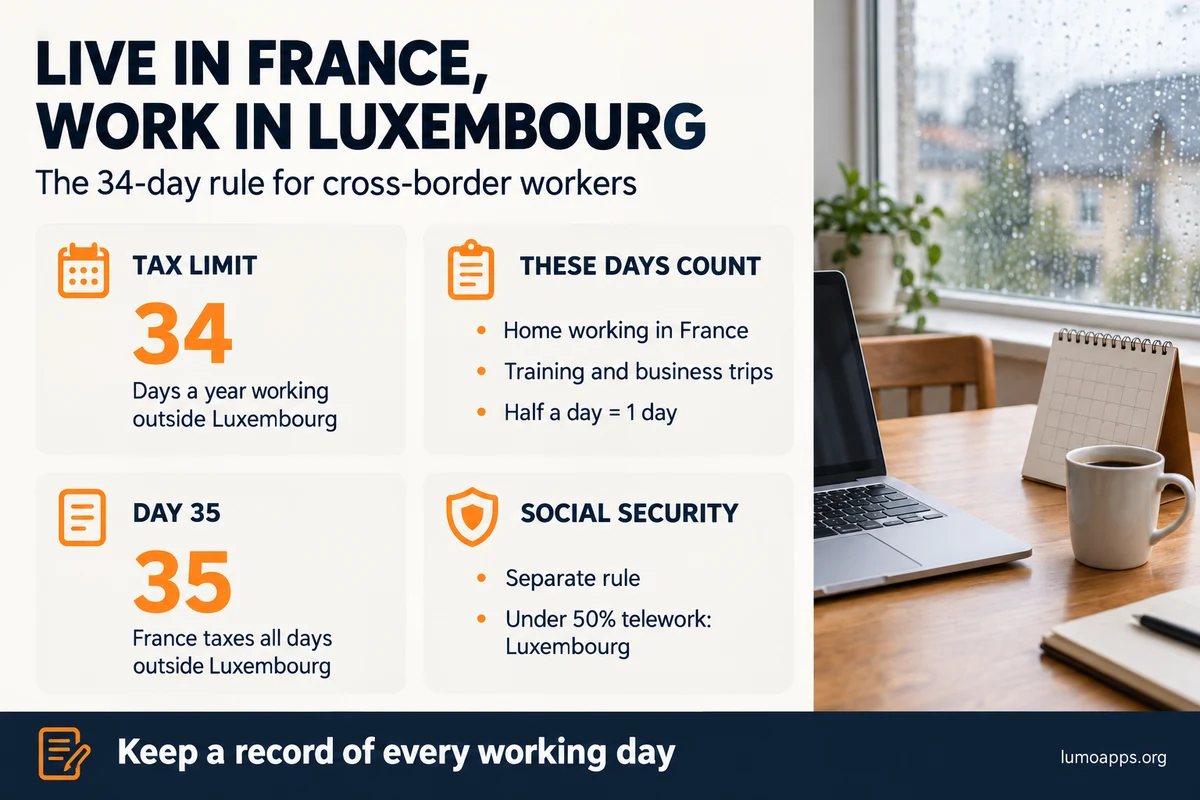
The 34-day rule in short
Under the France–Luxembourg tax treaty of 20 March 2018, a salary is normally taxed where the work is done. A day you work from your kitchen in Metz or Thionville is, in principle, a French tax day.
Point 3 of the treaty's protocol makes an exception. If a resident of France spends no more than 34 days in a calendar year physically working in France or in a third country, the whole year counts as worked in Luxembourg. The salary is then taxed only in Luxembourg.
The limit used to be 29 days. An amendment signed on 7 November 2022 raised it to 34 for income from 1 January 2023. France approved it by a law of 17 February 2025, and it entered into force on 4 March 2025, with effect back to the 2023 tax year. The government of Luxembourg confirmed on 23 July 2026 that the limit is still 34 days.
The rule does not depend on your nationality. A Portuguese, Romanian or French employee of a private Luxembourg company who is tax resident in France counts days the same way. State employees follow a separate article of the treaty: only French nationals without Luxembourg nationality fall under the 34 days.
Which days count towards the 34
The test is physical presence for work outside Luxembourg. The days of France and of any third country are added together. These days count:
- working from home in France;
- a training course in France or in another country, even for part of a day;
- a business trip, a client meeting or any other work trip outside Luxembourg;
- a day split between places: a morning at home in France and an afternoon in the Luxembourg office counts as a full day.
These days do not count: annual leave, weekends and public holidays when you are not required to work, sick leave, and force majeure beyond the control of you and your employer. Any day in France that is not a working day is outside the count.
Part-time work or a job that starts mid-year
The 34 days are reduced in proportion and rounded down. At 75% part-time the limit is 25 days (34 × 75% = 25.5). A full-time contract that starts on 1 July gives 17 days. At 75% from 1 October the limit is 6 days. The limit is per calendar year and shared by all your employment contracts in that year.
What happens on day 35
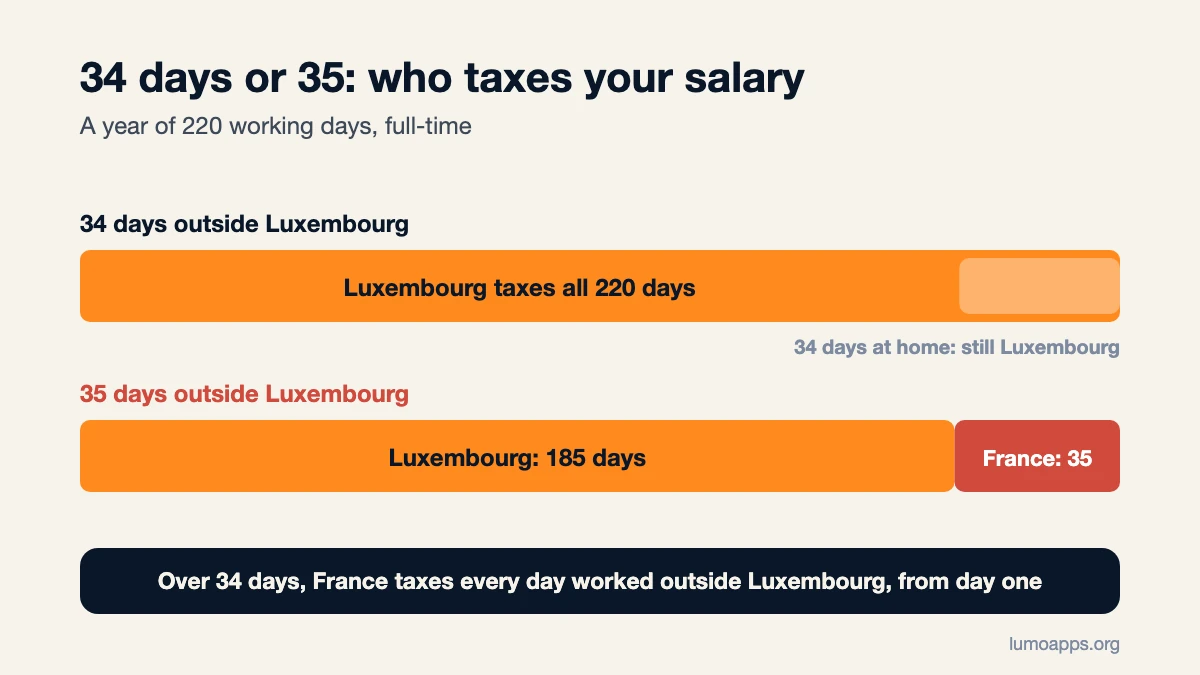
Once you go over the limit, the exception disappears for the whole year. France gains the right to tax the salary for all the days you worked outside Luxembourg, from the first day. Luxembourg keeps only the days worked on its territory.
| Working days in the year | Days outside Luxembourg | Taxed in Luxembourg | Taxed in France |
|---|---|---|---|
| 220 | 34 | 220 days (100%) | 0 days |
| 220 | 35 | 185 days | 35 days |
| 220 | 40 | 180 days | 40 days, not 6 |
Luxembourg's tax office published a new circular on 24 June 2026. It adds one detail: once the limit is exceeded, a day split between France and Luxembourg still counts as a full day for the 34-day test, but only half of it is taxed in France. French official guidance does not repeat this point yet.
Example: counting days through the year
Ana lives in Thionville and works full-time for a bank in Luxembourg City. Her contract gives about 220 working days a year. She keeps a simple tally:
| Period | Days outside Luxembourg | Running total |
|---|---|---|
| January–March | 12 days at home | 12 |
| April–June | 10 days at home, 2 days of training in Paris | 24 |
| July–September | 6 days at home | 30 |
| October–December | ? | no more than 34 |
By 30 September Ana has used 30 days. She has 4 left for the last quarter. If in December she works a fifth full day from home, that is day 35. France would then tax 35 days of her salary, not one. Even a morning at home before an afternoon in the office would count as day 35.
Her two weeks of summer leave in Portugal and the days she was off sick are not in the tally. A day in Brussels for a client meeting would be.
How to declare it
In France you declare your Luxembourg salary every year, even when it is taxed only in Luxembourg. The gross salary goes on form 2047 and then on form 2042, in box 1AF and box 8TK. France gives a tax credit equal to the French tax on that income, so in practice it only raises the rate applied to your other French income.
If you went over 34 days, the salary for the days taxed in France goes in box 1AG, and France taxes it normally, without that credit. From 2024 income onwards, the old transitional method no longer applies; only the treaty method does.
In Luxembourg, when the limit is exceeded, the employer withholds Luxembourg tax only on the share of salary for days worked in Luxembourg. The salary is split in proportion to working days, without counting leave.
Keep proof of your days
You have to prove that you stayed within the limit. The tax authorities list the kind of evidence that helps: a contract or employer certificate showing the place of work, timesheets, named travel tickets, hotel bills, attendance lists for meetings and training, and card payments in the country where you worked. A daily record of where you worked, kept as you go, is easier to defend than a reconstruction in April.
Social security is a different count
The 34 days are a tax rule. Social security follows EU Regulation 883/2004. As a rule, if you work at least 25% of your time in France, you are insured in France.
Since 1 July 2023, France and Luxembourg both apply the EU framework agreement on cross-border telework. With telework from home of 25% to less than 50% of your working time, you can stay in Luxembourg's social security system. Your employer must apply through SECUline, and the CCSS then issues an A1 form for up to three years. Since 1 July 2024 the request can go back no more than three months.
For scale: in a year of 220 working days, 34 days is about 15.5%. You can stay well under the social security thresholds and still go over the tax limit.

Will the limit go up?
Not yet. In an answer of 5 January 2026, the government of Luxembourg said it was ready to raise the limit to 25% of working time, while France had proposed 40% with annual compensation. No new amendment has been signed. The circular of 24 June 2026 and the answer of 23 July 2026 both still refer to 34 days, and no extra tolerance was granted for the summer 2026 closure of the Luxembourg–Bettembourg rail line. Until a new text is published, plan your year on 34 days.
Frequently asked questions
Does a half day at home count as a full day?
Yes, for the 34-day limit. Any part of a working day spent in France or a third country counts as one day.
Do business trips to Germany or Belgium count?
Yes. Days worked in any country other than Luxembourg are added to your days in France.
I worked 36 days outside Luxembourg. Are only the two extra days taxed in France?
No. Once you exceed 34 days, France taxes the salary for all 36 days worked outside Luxembourg.
Do holidays in France count?
No. Annual leave, weekends, public holidays and sick days are not working days and are not counted.
I work 80% part-time. What is my limit?
34 × 80% = 27.2, rounded down to 27 days for a full year.
This article is general information, not tax advice. Check your own situation with the French tax office or Luxembourg's Administration des contributions directes. Sources: France–Luxembourg tax treaty of 20 March 2018, protocol point 3 and amendment of 7 November 2022; mutual agreement of 16 July 2020; ACD circular L.G. – Conv. D.I. n° 61 of 24 June 2026; impots.gouv.fr guidance and notice 2047; answers to parliamentary questions n° 3216 and n° 4364 (Chambre des Députés); CCSS and CLEISS pages on cross-border telework.
