
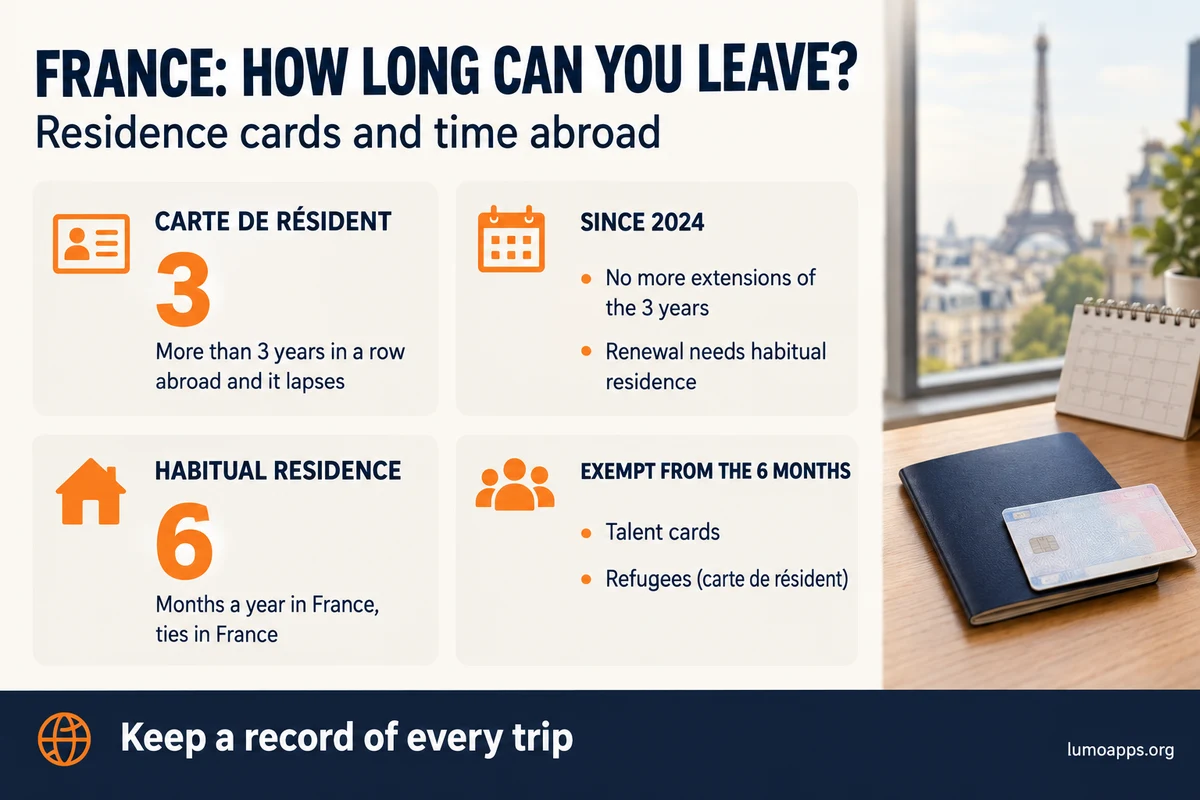
How long can you leave France with a carte de séjour? It depends on the card. A 10-year carte de résident stops being valid if you live abroad for more than three years in a row, and since January 2024 you can no longer ask to extend that period. Temporary and multi-year cards have no fixed limit, but to renew a multi-year card or a carte de résident you now have to show that you really live in France: your main ties are there and you spend at least six months a year in the country.
The short answer by type of card
| Card | When it stops being valid | What renewal requires |
|---|---|---|
| Carte de résident (10 years) | After more than 3 years in a row living abroad | Habitual residence in France, unless you are a refugee |
| Résident de longue durée-UE | After more than 3 years in a row outside the EU, or 6 years in a row outside France | Habitual residence in France |
| Carte de séjour pluriannuelle | No fixed absence limit | Habitual residence in France, except for talent cards and some protection cards |
| Carte de séjour temporaire | No fixed absence limit | You still meet the conditions the card was issued for |
Carte de résident: the three-year rule
Article L. 411-5 of the French immigration code (CESEDA) says that a carte de résident lapses when its holder has left France and lived abroad for more than three consecutive years. The date printed on the card does not matter: a card valid until 2030 can lapse in 2026.
Until 28 January 2024 you could ask the préfecture to extend the three-year period, either before leaving or while abroad. The immigration law of 26 January 2024 removed that option. The current text has no exceptions for retirees, students or people abroad for medical treatment.
The préfecture can also withdraw a valid carte de résident after more than three years abroad. Before doing so, it must tell you what it plans to do and let you respond.
Long-term EU resident cards
A French «résident de longue durée-UE» card lapses in three cases:
- you live outside the EU for more than three years in a row;
- you live outside France for six years in a row, even if you spend that time in another EU country;
- you obtain long-term resident status in another EU country.
The EU directive on long-term residents sets a shorter limit of 12 months outside the EU, but it allows countries to accept longer absences, and France chose three years. A revision of the directive that would raise the EU limit to 24 months has not been adopted, so the French rules have not changed.
Temporary and multi-year cards
A carte de séjour temporaire or pluriannuelle does not lapse after a set time abroad. The risk comes at renewal. The préfecture can refuse to renew a card if you no longer meet the conditions it was issued for, for example if you stopped studying or working in France.
Since 2024, renewing a multi-year card also requires habitual residence in France. This does not apply to the «talent» family of cards, subsidiary protection or stateless persons. For a carte de résident, refugees and their families are exempt.

What “habitual residence” means since 2024
Article L. 433-3-1 of the CESEDA sets two conditions, and you need both:
- the centre of your private and family interests has moved to France;
- you have spent at least six months in France «au cours de l'année civile» over the three years before your application, or over the whole life of your card if it is shorter than three years.
The official text does not say whether the six months are needed in each of the three years or only overall, nor whether they must be consecutive. The safest reading is six months in France in every calendar year. Keep evidence of where you were: a lease, bills, payslips, school records and your own record of travel dates.
A worked example
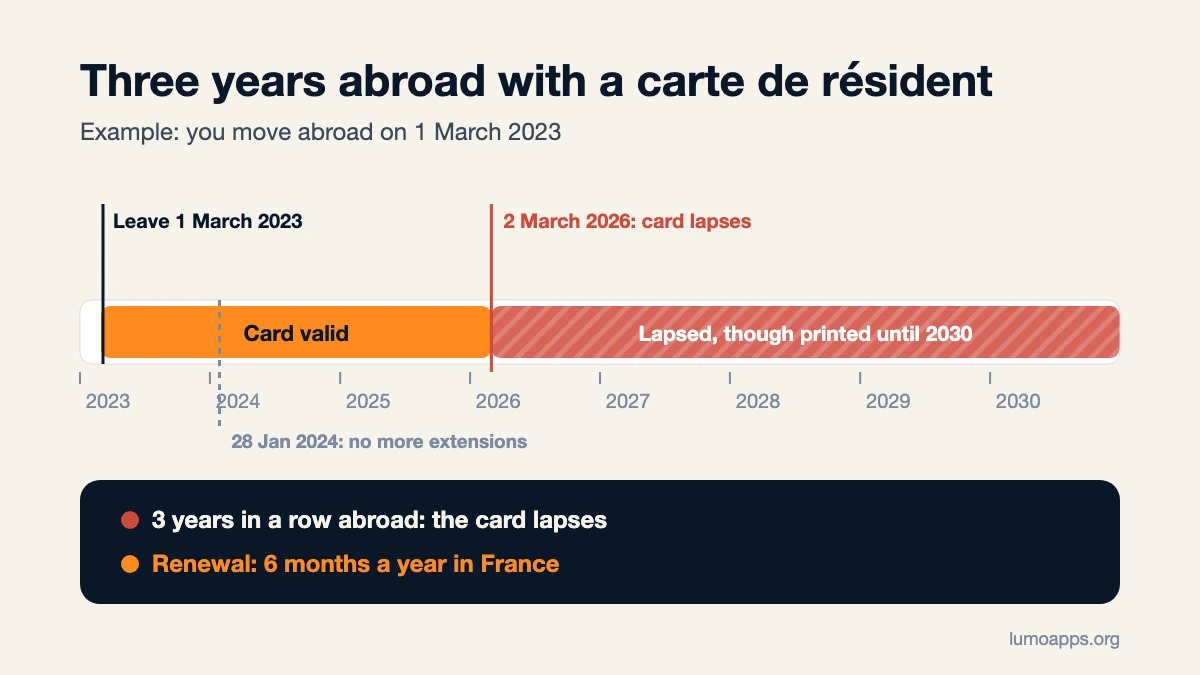
Say you hold a carte de résident valid until 2030 and move to Dubai on 1 March 2023. You live there without coming back to settle in France.
| Date | What happens |
|---|---|
| 1 March 2023 | You move abroad; the three-year count starts |
| 28 January 2024 | The option to ask for a longer period disappears |
| 1 March 2026 | Three years abroad are complete |
| 2 March 2026 | The card lapses, even though it says 2030 |
Now change one detail: you spend four months in Paris every summer. The card does not lapse on its own, because you have not lived abroad for three years in a row. But when you renew it in 2030, you must prove habitual residence for 2027 to 2029, and four months a year falls short of six. The préfecture can refuse the renewal.
Coming back to France
- With a valid card: you return with your passport and card.
- During a renewal: the récépissé for a renewal lets you come back. An attestation de prolongation d'instruction works only together with your expired card.
- During a first application: a récépissé or attestation de dépôt is not enough; you need a visa de retour from a French consulate.
- Card lost or stolen abroad: report it to the local police and the French consulate and ask for a visa de retour. Apply for a duplicate online through ANEF once you are back.
- Retired abroad with a French pension: former holders of a carte de résident can apply for a 10-year carte de séjour «retraité», which allows visa-free stays of up to one year at a time but not work.
If you apply for renewal late, a 180 € regularisation fee is added to the price of the card, unless you had a valid visa or a case of force majeure.
Common mistakes
- Trusting the expiry date. A carte de résident printed as valid until 2030 can lapse years earlier.
- Counting on an extension. Requests to extend the three-year period ended on 28 January 2024.
- Assuming a short visit resets the clock. The law speaks of living abroad, not of being physically absent. No official guidance says that a few days in France restart the three years.
- Confusing the card with tax residency. French tax residency follows its own tests in Article 4 B of the tax code. More than six months in France is only an indication there, not an absolute rule.
- Forgetting naturalisation. French citizenship normally requires five years of habitual residence in France before you apply, so long absences can delay it.
Keep track of your days
Both limits are about time: three years abroad for a carte de résident, six months a year in France for a renewal. Write down every departure and return date and keep your evidence in one place. Lumo Travel counts the days you spend in each country, so before you file a renewal you can see whether you reached six months in France each year.
Frequently asked questions
Does a short trip to France reset the three-year count?
Not clearly. The law refers to living abroad for more than three consecutive years, and no official guidance says a short visit restarts the count. Do not rely on it.
Can I still ask to keep my carte de résident while I live abroad?
No. Since 28 January 2024 the three-year period can no longer be extended on request, and the law has no exceptions by category.
Do I need six months in France every year?
For renewing a multi-year card or a carte de résident, the law requires six months in France per calendar year over the last three years. It does not say whether this means every year, so plan for six months in each year.
Does the six-month rule apply to a talent card?
No. Multi-year «talent» cards are exempt from the habitual residence check at renewal, as are subsidiary protection and stateless persons' cards.
My carte de résident lapsed. How do I return?
The official pages do not describe a specific route. Contact the French consulate where you live before you travel. Retirees with a French pension may qualify for the carte de séjour «retraité».
This article is general information, not legal advice. Rules change; check your situation with your préfecture or a French consulate before you travel. Sources: CESEDA articles L. 411-5, L. 432-2, L. 432-3, L. 433-1 to L. 433-3-1 and L. 426-8 (Légifrance); loi n° 2024-42 of 26 January 2024; service-public.gouv.fr pages F2208, F17359, F35799, F12189, F21032 and F2710; Directive 2003/109/EC; Code civil article 21-17; Code général des impôts article 4 B.
